Discover careers in Forestry and Arboriculture
Do you know the difference between forestry and arboriculture?
Forestry is the science and practice of planting, managing and harvesting wood and timber.
Arboriculture is the practice of cultivating and managing trees in urban environments such as, parks, community gardens and private properties.
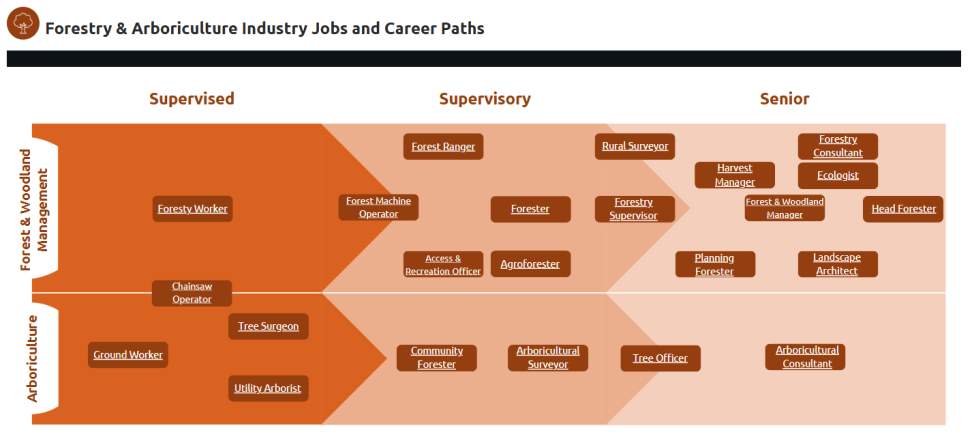
There can be some overlap but generally foresters manage woodlands and timber on a larger scale and arborists look after trees in green spaces. Both careers offer a diverse and challenging environment with broad opportunities.
Forestry contributes 19.3 billion to the UK economy and employs around 560,000 workers. As such, it makes a significant contribution to the UK’s economy, environment, and culture.
However, what we need from forests and how we design and plant them might well be different in future, and so the sector needs talented, smart and enthusiastic people to design the landscapes of tomorrow. New technologies will also allow us to plan and monitor smartly over a bigger scale than ever before.
Tree Surgeons carry out a variety of tree-focused work spanning the whole lifetime of a tree, from planting to removal. This work regularly requires the climbing of trees and working at heights, sometimes for hours at a time, which can be very physically demanding. Often, Tree Surgeons use heavy…
Silviculture Researchers study how woods and forests are established, managed and regenerated. Their work helps improve woodland resilience, productivity, biodiversity and long-term sustainability by investigating topics such as tree species selection, planting design, soil condition, climate…
Agroforestry combines agriculture and trees on the same area of land to improve productivity, biodiversity, soil health, animal welfare and climate resilience. Agroforestry roles may involve planning and managing systems such as shelterbelts, silvopasture, alley cropping or woodland grazing.
Coppicing is the traditional management of woodland by cutting certain trees on a cycle so that they regrow from the stump. This produces sustainable timber and small wood products while also creating valuable habitat for wildlife. Coppicing is both a practical woodland skill and an important…
Search the LANSS database for current courses and opportunities
Forestry + Woodlands